

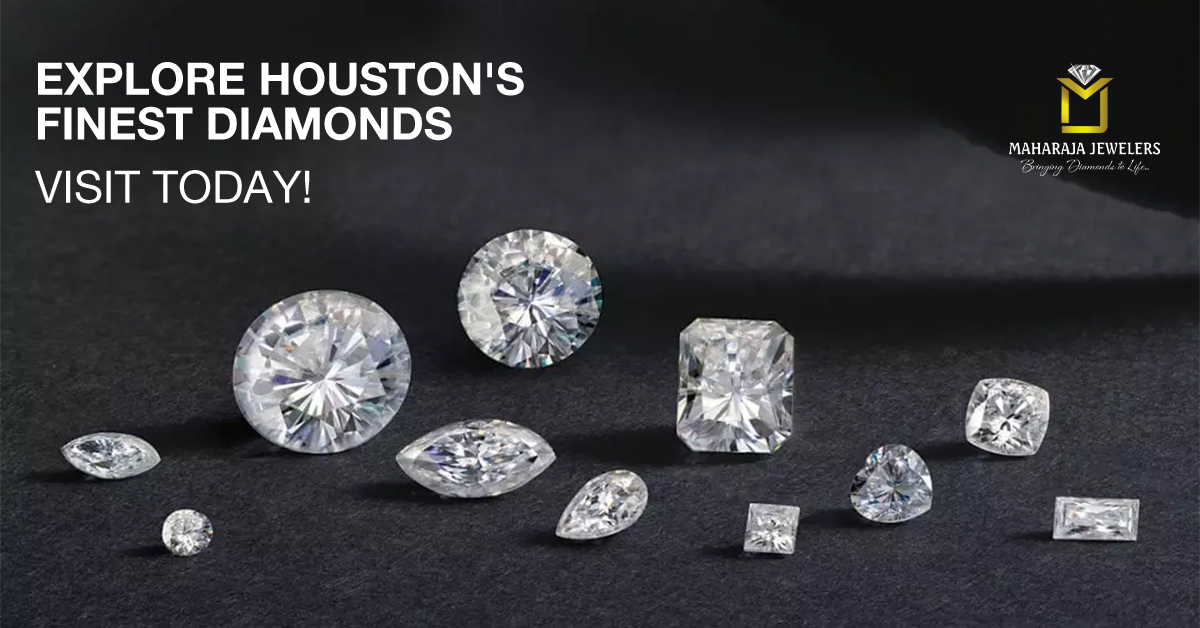
Most people shopping for a diamond engagement ring or a custom piece start the process completely backwards. They walk into a store, fall in love with a finished ring, and then find out that the diamond inside it is whatever was available at the price point. Buying a loose diamond flips that process. You pick the diamond first, evaluate it on its own merits, and then build the piece around it. For anyone who cares about what they are actually getting, that order makes a significant difference.
Houston has a strong loose diamond market, particularly on the Hillcroft corridor, and if you have not considered buying loose diamonds before, here is what it actually means in practice.
You Can Evaluate the Diamond Itself, Not the Setting It Came In
When a diamond is set in a ring or a pendant, the metal around it obscures parts of the stone. Prongs cover inclusion spots. The reflection of the metal affects how you perceive the color. You cannot tilt the stone toward the light and watch how it performs because it is fixed in place. You are essentially buying a diamond you cannot fully see.
A loose diamond is evaluated completely on its own. You can hold it under a loupe, examine the cut from multiple angles, check how the facets direct light, and compare its performance against other stones of similar weight and grade. If a stone is graded I1 for clarity, you can see exactly where the inclusions sit and decide whether they bother you. That transparency simply does not exist when a diamond is already mounted.
The 4 Cs Mean More When You Can Actually Apply Them
Carat, cut, color, and clarity are the four criteria used to grade every diamond. Understanding them is useful, but most buyers cannot apply them well when shopping for mounted diamonds because they cannot isolate the stone from its setting. With a loose diamond, the 4 Cs become practical tools instead of a vocabulary exercise.
Cut is the most important factor for how a diamond looks to the naked eye, and it is the one most buyers under-evaluate because finished rings are presented in flattering lighting. A well-cut stone in the G-H color range with VS2 clarity will outperform a poorly cut D-color stone in almost every real-world lighting condition. When you are evaluating loose stones, you can actually test this instead of just reading a certificate.
At Maharaja Jewelers, every loose diamond comes with a GIA or equivalent grading certificate. The certificate tells you what the stone is. Looking at the stone yourself tells you whether you like it. Both matter.
Loose Diamonds Give You Control Over the Setting
A loose diamond purchase is almost always paired with a custom or semi-custom setting, and that combination is where you get something that no retail chain can offer. Your stone, your metal choice, your setting style, your prong shape. If you have a specific ring design in mind, starting with the diamond and building outward is the only reliable way to get there.
This matters especially for buyers with specific cultural preferences. Traditional Indian bridal jewelry and Western solitaire settings require completely different mounting approaches, different prong heights, different metal weights, and different proportions. A loose diamond purchase makes all of that possible because the stone is not pre-committed to a design you did not choose.
Pricing: Why Loose Diamonds Often Cost Less for the Same Quality
When you buy a finished ring at a chain retailer, you are paying for the diamond, the setting, the labor to set it, the brand markup, and the overhead of the retail location. You have no visibility into which part of the price is which. A loose diamond has a more transparent price because it has not accumulated the additional costs of being finished into a piece.
That does not mean loose diamonds are cheap. A well-cut, GIA-certified 1-carat diamond in the G color, VS1 clarity range is a real investment regardless of where you buy it. But when you purchase it loose, you can compare that specific stone’s certificate and price against other vendors. That comparison is essentially impossible with finished rings because no two rings are configured the same way.
We price our loose diamonds at Maharaja Jewelers to reflect the actual stone, not a bundled retail experience. If you want to understand what you are paying for, we will walk you through the certificate with you in person.
Conflict-Free and Responsible Sourcing
The diamond industry has changed significantly over the past two decades due to the Kimberley Process and increased consumer awareness around sourcing. Buying a certified loose diamond is the most direct way to verify that the stone you are purchasing has a documented chain of custody.
When you purchase from us, we can tell you the origin documentation on any stone in our inventory. For buyers who care about where their diamond came from, that documentation is only meaningful when you are looking at the stone and its paperwork together, which is exactly what a loose diamond purchase allows.
Lab-grown diamonds are a separate category worth mentioning here. If you are open to a lab-created stone, loose lab-grown diamonds offer the same optical and physical properties as mined diamonds at roughly 50 to 70 percent lower cost as of 2026. We carry both and are happy to explain the trade-offs without pushing you toward either.
Custom Design at Maharaja Jewelers: How the Process Works
Once you have selected a loose diamond, the design process for the setting is straightforward. You share a reference image, a sketch, or just describe what you want in terms of the setting style, metal, and any additional stones. Our in-house designers translate that into a wax model or CAD rendering so you can see the proportions before anything is cast.
The timeline from stone selection to finished piece is typically three to four weeks, depending on the complexity of the setting. Bridal sets with multiple stones and detailed metalwork take longer. Simple solitaire settings can be completed faster. We provide updates throughout the process, and if you want to see the piece at the wax stage, we welcome that.
What to Bring When You Come In
If you are coming to evaluate loose diamonds for the first time, a few things will make the visit more productive. Bring a reference image of any ring styles you like, even just pulled from Pinterest. Know your partner’s ring size if you are buying a surprise engagement piece. If you have a budget range, share it honestly so we can show you stones that represent the best value within that range rather than everything in the case.
We do not pressure buying decisions at Maharaja Jewelers. Loose diamond purchases are considered purchases, and we understand that. Most people who buy from us visit two or three times before making a decision, and that is completely normal for something this significant.
FAQs About Buying Loose Diamonds
Not if you are working with a jeweler who does custom work in-house. At Maharaja Jewelers, the setting is made specifically for your diamond, so fit is never an issue. The challenge only arises if you try to set a stone at a different jeweler than where you bought it, which we recommend against because responsibility for the stone gets unclear.
No. A GIA certificate grades the objective properties of the stone. A diamond can have excellent grades and still be cut in a way that does not maximize its visual performance. That is why seeing the stone in person matters more than any certificate. The certificate confirms the facts; your eyes confirm whether you love it.
Yes. We offer flexible payment plans for loose diamond purchases above a certain threshold. Ask us about current financing options when you come in, as terms change periodically.
A loose diamond refers to any unmounted diamond, whether mined or lab-grown. Lab-grown refers to how the diamond was created, not how it is sold. Both mined and lab-grown diamonds can be purchased as loose stones.
Mined diamonds in certified quality ranges (G-H color, VS2-SI1 clarity, excellent cut) have historically held their value reasonably well compared to other luxury goods, though they are not liquid assets in the way that gold is. Lab-grown diamonds have dropped significantly in resale value as production has increased. If resale value matters to your purchase decision, mined loose diamonds are the more stable choice.