

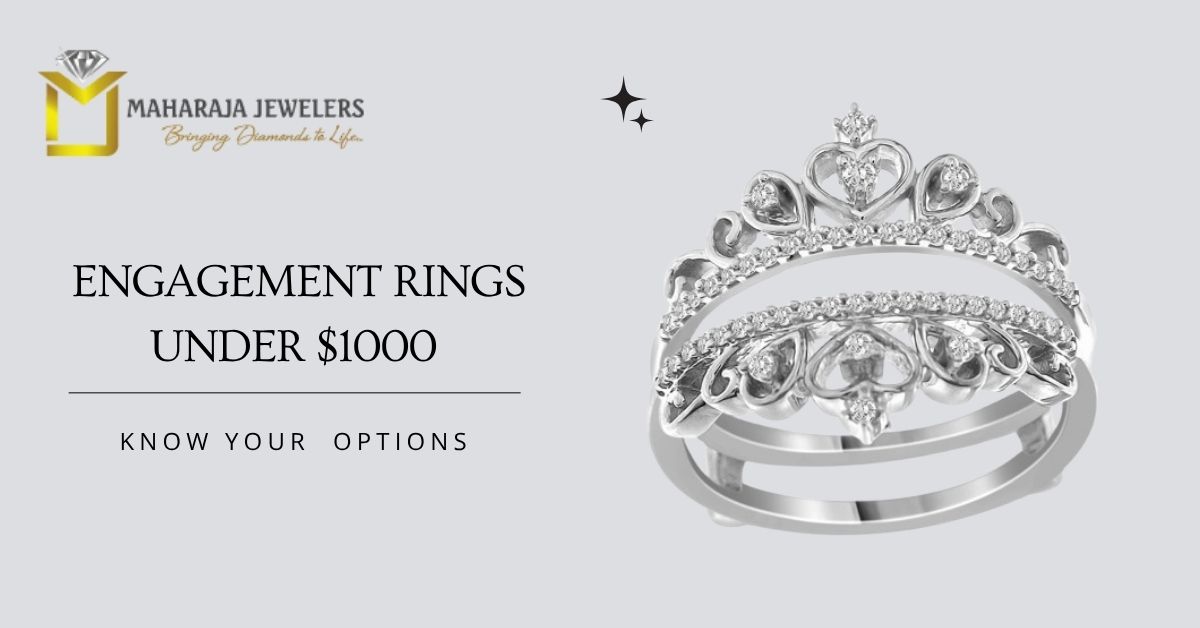
What to Expect When Buying Engagement Rings Under $1000?
The average American engagement ring spend in 2024 was around $5,500. That number gets repeated everywhere, which makes a lot of people feel like a $1,000 budget is not enough to find something real. It is enough. It just requires making deliberate choices instead of defaulting to whatever a retailer places in the center of the case.
This guide tells you exactly what fits inside a $1,000 engagement ring budget, what compromises you are making and whether they actually matter, and how to spend the money where it counts most.
What $1,000 Actually Buys You?
Before breaking this down by category, here is the honest overview. At $1,000 you can buy a real diamond engagement ring. It will not be a large diamond. It will be a well-made ring with a genuine stone that looks beautiful in person and photographs well. You cannot buy a 1-carat round brilliant solitaire in 18-karat gold at this budget. You can buy a 0.30 to 0.50 carat diamond in a well-designed setting, or a larger lab-grown diamond, or a colored gemstone center stone that is significantly more visually impactful per dollar than a small white diamond.
The single most important decision in this budget range is not which store you shop at. It is which trade-offs you are willing to make.
Diamonds at This Budget: What the Numbers Look Like
If you want a mined diamond, your workable range is roughly 0.25 to 0.45 carats. Within that range, here is where to put your priority:
Cut matters most. A well-cut 0.30-carat diamond outperforms a poorly cut 0.50-carat stone in every real-world lighting condition. GIA grades cuts as Excellent, Very Good, Good, Fair, and Poor. Stay at a Very Good or Excellent cut and compromise on the other factors if needed.
Color is the second priority. G, H, or I color grades look white to the naked eye in most settings. The difference between a D (perfectly colorless) and an H becomes visible only under magnification or direct comparison. H color in a white gold or platinum setting is indistinguishable from D to anyone who is not a gemologist. Save the money.
Clarity is the safest place to compromise. SI1 and SI2 clarity grades mean the stone has inclusions, but they are not visible without a 10x loupe. In a ring worn on a hand at normal viewing distance, an SI1 diamond looks identical to a VVS stone. The price difference between VS2 and SI1 at the same carat and cut can be 20 to 40 percent. That is a meaningful saving at this budget level.
Shape is the second-biggest lever after cutting. Round brilliant diamonds cost a premium because they are the most in-demand cut and they produce the most waste in the cutting process. An oval, cushion, or pear shape in the same carat weight will cost 15 to 25 percent less than a round and will often appear larger on the finger due to the elongated shape.
Lab-Grown Diamonds: The Most Practical Choice at This Budget
Lab-grown diamonds are optically, chemically, and physically identical to mined diamonds. A gemologist cannot tell them apart without specialized equipment. The price difference as of 2026 is roughly 50 to 70 percent in favor of lab-grown stones.
What that means practically: a mined SI1, G-color, Very Good cut, 0.35-carat round diamond might cost $600 to $800 for the stone alone. A lab-grown stone with identical grades in a larger size, around 0.75 to 1 carat, can be found in the same price range, leaving more of your $1,000 budget for the setting.
The trade-off is resale value. Lab-grown diamond prices have dropped significantly since 2022 as production has scaled. If you sell a lab-grown ring in ten years, you will recover very little of the purchase price. If that does not concern you, a lab-grown stone is the clearest way to maximize the visual impact of your budget.
Colored Gemstones: Where This Budget Gets More Impressive
Sapphires, rubies, emeralds, and morganite offer a dramatically different value equation than diamonds. A 1-carat blue sapphire in a good quality range (not heat-treated to an extreme, eye-clean, well-cut) costs significantly less than a comparable diamond and is visually much more present on the finger. A 1-carat sapphire engagement ring in 14-karat gold is well within $1,000 and looks nothing like a budget ring.
Moissanite is worth mentioning separately. It is not a diamond, but it has a higher refractive index than diamond, which means it produces more fire and light dispersion. Some buyers love this; others find it a little much compared to the more restrained brilliance of diamond. It is durable enough for everyday wear (9.25 on the Mohs scale, compared to diamond’s 10) and costs a fraction of a comparable diamond. A 1-carat moissanite center stone in a well-made setting is possible for well under $500, leaving significant budget for a quality setting.
Metal Choices at This Budget
Stick to 14-karat gold. It is the right choice at this price point for three reasons. First, it is durable. 18-karat gold is softer and dents more easily; 10-karat gold is harder but has a noticeably less rich color. 14-karat hits the balance. Second, it is affordable. 18-karat gold costs more for the same metal weight. Third, it is the standard for American engagement jewelry, so resizing, repairs, and additions are easy to source anywhere.
Yellow, white, and rose gold in 14-karat are all good options. White gold requires rhodium plating to maintain its color over time (every one to three years depending on wear), which is a minor maintenance consideration worth knowing. Rose gold does not require replating and has become increasingly popular as a setting choice over the past decade.
Platinum is not a realistic option at this budget. A plain platinum band for an engagement ring starts at $800 to $1,200 before any stone. Unless you are buying a very simple setting with a very small stone, platinum will consume most of your $1,000 before the diamond is purchased.
Silver is not appropriate for an engagement ring. It is too soft for daily wear, tarnishes, and cannot be reliably resized without risk of deformation. Any jeweler who tries to sell you a silver engagement ring as a serious option is not looking out for your interests.
Setting Styles That Work at This Budget
A solitaire setting is the most budget-efficient choice. There is one stone and one prong structure or bezel, minimal metalwork, and the full visual focus goes to the center stone. For a small diamond, this is often the right call because a halo setting on a 0.25-carat stone can look busy rather than elegant.
A halo setting adds a ring of small diamonds around the center stone, making it appear larger. This works well if your center stone is a gemstone rather than a diamond, because the contrast between the colored center and white diamond halo is visually striking without requiring a large center stone. A halo setting adds cost for the additional stones and the more complex metal work, which means less budget for the center stone.
A pave or micro-pave band adds small diamonds along the band itself. This is decorative rather than functional but significantly elevates the appearance of a modest center stone. A 0.30-carat solitaire on a plain band reads as small. The same stone on a pave band reads as a complete, designed piece.
What to Look for Before You Buy
Every engagement ring purchase at this budget should clear four checks. First, ask for the diamond certificate. GIA certification is the gold standard. EGL and IGI certifications exist but grade less consistently than GIA. If a stone is described as “certified” without specifying the lab, ask which lab before you agree to any price.
Second, look at the stone under the store’s loupe yourself. You do not need expertise. You need to see whether the inclusions in an SI1 or SI2 stone are positioned where they will be visible when the ring is worn. Inclusions near the edge of the stone, away from the center, are largely hidden by the prongs. Inclusions directly in the table (the flat top of the diamond) are visible in normal lighting.
Third, check the prong quality. On a small budget ring, prongs are sometimes poorly finished, too thin, or unevenly placed. Thin prongs wear down with daily wear and can release the stone. Run your fingernail across each prong. They should feel smooth and even, not sharp or rough.
Fourth, ask about the return and resize policy before you purchase. Ring sizing after a proposal is extremely common. A jeweler who does not offer at least one free resize within 90 days is asking you to accept a known limitation that will likely matter.
What Maharaja Jewelers Can Do at This Price Point
Our Hillcroft Street location carries loose diamonds and a range of setting styles that work within a $1,000 budget. We can show you mined and lab-grown options side by side so you can see the visual difference yourself rather than making the decision based on a certificate alone.
Custom work is available at this budget for simpler designs. A solitaire or modest halo in 14-karat gold with a lab-grown center stone can be produced as a custom piece without exceeding $1,000 in most configurations. More complex settings with significant pave work, multiple gemstones, or heavier metal weight may push past that number.
Come in with a reference image of what you like and we can tell you within a few minutes whether it is achievable at your budget and what modifications, if any, would bring it within range.
Frequently Asked Questions
No. The idea that an engagement ring must cost a certain amount comes from marketing campaigns, not any meaningful cultural standard. What matters to the person wearing it is that it was chosen thoughtfully for them. A $900 ring bought with care and knowledge is a better gift than a $3,000 ring bought impulsively from a chain store.
It depends on the hand. A 0.35-carat round diamond on a slender finger with a well-proportioned setting looks elegant and intentional. The same stone on a larger hand in a plain solitaire setting can look small. A jeweler who asks to see a photo or tracing of your partner’s hand before recommending a stone size is giving you genuinely useful advice.
Yes, many jewelers including Maharaja Jewelers offer trade-in programs. The terms vary, so ask specifically whether the trade-in applies to the stone, the setting, or both, and whether the credit is based on original purchase price or current market value.
It is durable, brilliant, and a fraction of the diamond price. The main consideration is whether your partner cares whether the center stone is a diamond specifically. Some people do. Some people prefer the higher fire of moissanite over diamond. It is worth having that conversation honestly rather than presenting moissanite as if it is diamond.
The most reliable method is to borrow a ring your partner already wears on their ring finger and trace the inside of the band on paper. A jeweler can measure that tracing. If borrowing a ring is not possible, the average women’s ring size in the US is 6 to 6.5, and one free resize is standard practice. Slightly too large is easier to resize than slightly too small.